The short answer
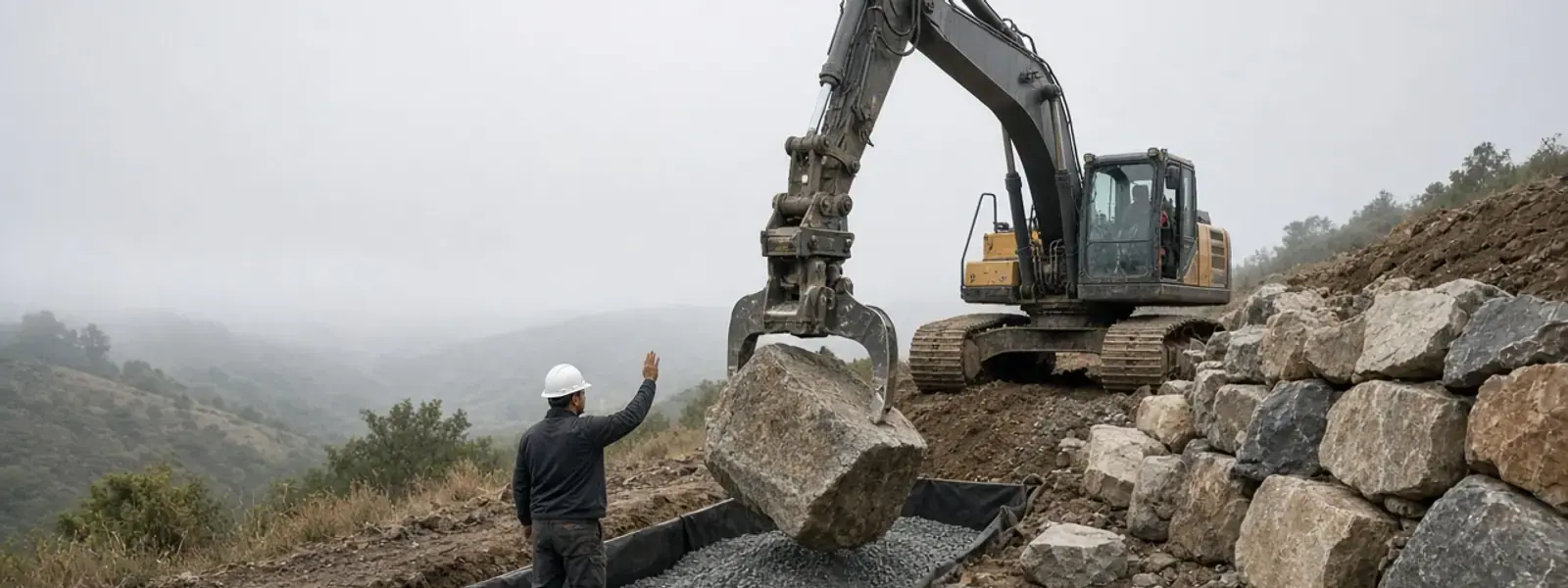
Boulder retaining walls in San Francisco use large rocks, from a few hundred pounds to several tons, set by an excavator in a keyed base with a backward lean, filter fabric and drainage behind them. San Fran Retaining Wall Pros builds boulder walls for slopes, driveways and rough access, and we'll tell you honestly whether your lot can take the equipment and the weight.
What a boulder retaining wall actually is
A boulder retaining wall is a gravity wall. Big rocks stacked with a lean toward the slope hold soil back by sheer weight and friction. There's no mortar and no reinforcement. The wall works because each rock is heavy enough to stay put and because the rocks are set in a way that spreads load down through the stack.
They're common on hillsides, along driveways, near creeks and on larger properties, including in Marin, the peninsula and the hills above the East Bay. They also appear in front yards in the city, where a short boulder wall can turn a steep patch into planting pockets.
A properly built boulder wall isn't a pile of rocks. It's a designed stack with a trench, a base, a controlled lean, drainage and a fabric barrier that keeps soil from washing through the voids.
Boulder sizes and what they weigh
| Class | Approximate dimension | Approximate weight | Typical use |
|---|---|---|---|
| Small | 12 to 24 in | 100 to 500 lb | Low garden walls, planting pockets, accent rocks |
| Medium | 24 to 36 in | 500 to 2,000 lb | Most residential walls up to about 4 ft |
| Large | 36 to 48 in | 2,000 to 4,000 lb | Taller walls, driveways, steeper slopes |
| Extra large | 48 in and up | 4,000 lb and up | Heavy base courses and larger sites |
Rock type changes weight. Granite runs about 165 pounds per cubic foot. Sandstone is a bit lighter. Basalt is on the heavy side. A rock the size of a washing machine can weigh a ton or more, so the machines have to match.
Equipment and access: the make-or-break question
You can't set a boulder wall by hand. It needs an excavator with a thumb or a grapple, a skid steer with forks, or a small crane for rock that has to be lifted into place. That means the site has to take the machine.
- A compact tracked excavator is roughly five to six feet wide, so gates and side yards need that clearance
- Boulders arrive on a flatbed or dump truck and need a place to be staged
- The slope has to be stable enough to work on, or the machine needs a ramp or a bench
- Overhead lines and tree canopy can limit the reach of the boom
- Utility lines under the work area need to be located first through USA North 811
On a stairs-only lot, a boulder wall usually isn't possible. For those sites, a stone veneer or block wall that can be hand-carried makes more sense. We'll tell you at the walk-through, not after the truck is booked.
The base, the key and the lean
- Excavate a trench wide enough for the base boulders and a compacted rock bed, deep enough to bury the first course by roughly a third to a half of its height.
- Line the trench and the slope face with nonwoven filter fabric, leaving enough extra to wrap over the top of the drainage rock.
- Place and compact a crushed rock base, leveled to a laser or string line.
- Set the largest boulders in the base course with their flattest, widest faces down, and key them into the soil so they can't slide forward.
- Stack the next courses with a backward lean, called batter, commonly in the range of one inch of setback for every four to six inches of rise.
- Seat each rock on at least three points of contact, so it can't rock under load.
- Fill gaps between rocks with smaller stone and gravel, placed so soil can't wash through.
- Backfill behind the wall with clean crushed rock, wrap the fabric over the top and finish with soil or plantings.
The first course is the whole game. If it's keyed into the ground and sits on a solid base, the next courses have something to stand on. If it isn't, everything above it is at the mercy of the next wet winter.
Drainage, filter fabric and the voids between rocks
Boulder walls drain through the gaps between rocks, which is a strength and a weakness. Water gets out easily, but soil can wash out with it. If the soil behind the wall migrates through the voids, you get sinkholes behind the wall and rocks that start to shift.
The fix is a filter fabric wall behind the rocks, with a layer of clean crushed rock between the fabric and the soil. The fabric keeps fines from passing. The rock keeps water moving. A perforated drain pipe at the base takes concentrated flow to a daylight outlet. The overall approach is the same as every wall we build, which you can see on our drainage page.
Don't backfill with the dug-out soil
It's tempting to push the excavated clay back behind the rocks and call it done. Clay holds water, shrinks and swells and pushes the wall. Free-draining rock behind the wall is what keeps pressure low.
How tall can a boulder wall go?
Most residential boulder walls run between three and six feet. Taller walls are possible with very large rocks, a wide base and a design from an engineer, but at that point the wall becomes a structure more than a landscape feature.
A wall that's four feet or less from the bottom of the footing to the top, with no surcharge, is typically exempt from permits in California. A wall that supports a driveway, a house or a steep slope above, or a wall that's taller, needs engineering. Boulder walls are also sometimes designed with geogrid reinforcement or tied back into the slope for greater height.
Walls near creeks or drainages can involve other agencies, like regional water or fish and wildlife offices, depending on location. If your property touches a creek, tell us up front.
Where boulder walls make sense around the Bay
- Hillside driveways. A boulder wall along the uphill edge keeps the cut stable and handles runoff
- Creek and swale edges. Rock resists erosion and moves water through
- Coastal slopes. Salt air doesn't hurt rock the way it hurts steel or wood
- Larger lots in Marin and the peninsula. Space and access let the machine work
- Planting terraces. Pockets between boulders hold native plants and succulents
- Fire-conscious landscapes. Rock walls don't burn, which matters on hillside properties in wildland-urban areas
If you want a more refined look, a mortared stone wall offers smaller, more precisely fitted pieces. If drainage is the main issue, a gabion wall can be a closer fit.
Planting pockets and the finished look
A boulder wall softens fast when it's planted. Ceanothus, manzanita, sage, yarrow, coastal buckwheat, ice plant, aloes and ornamental grasses all do well in the gaps and on the slope above. Pockets of soil between rocks should be backed by filter fabric and fed by drip, not by a hose aimed at the face.
Color varies by stone. Gray granite is neutral. Tan and rust-colored sandstone warms a garden. Rounded river boulders give a different feel from angular quarried rock. Most boulder walls look best with mixed sizes and a natural, irregular top line, not a perfectly level cap.
Safe handling, and why the crew matters
Moving multi-ton rock near a house is not a casual job. Rigging, a spotter, a clear exclusion zone and a machine operator who understands how rocks seat all matter. We plan the lifts, mark the path and keep people out of the swing radius.
If you're comparing bids, ask who sets the rock, what machine they use, how they handle fabric and drainage, and how they plan to protect fences, hardscape and plants along the access route. The answers say a lot about how the wall will turn out.
Boulder Retaining Walls FAQ
How much space does an excavator need for a boulder wall?
A compact tracked excavator typically needs about five to six feet of width to get through a gate or side yard, plus room to turn and stage rock. We'll measure access on the walk-through to see whether a boulder wall is practical.
Do boulder walls need drainage?
Yes. The gaps between rocks help, but a filter fabric barrier, clean rock backfill and a perforated pipe at the base keep soil from washing through and keep water pressure down.
How tall can a boulder retaining wall be?
Most residential walls are three to six feet. Taller walls need larger rock, a wider base and engineering, and sometimes geogrid or tiebacks.
What kind of rock is best?
Angular, flat-faced rock stacks better and locks together. Granite, sandstone and basalt are all common. Round river rock looks nice but can be harder to stack tightly for a retaining wall.
Can I plant in a boulder wall?
Yes. Pockets between rocks work for drought-tolerant and native plants. Backing the pockets with filter fabric and using drip irrigation keeps the wall stable.
Are boulder walls permitted?
Walls over four feet from the bottom of the footing to the top, walls carrying a surcharge and walls in hazard areas generally need engineering and a permit. Shorter walls often don't. We check with your local building department.
More retaining wall services
- Stone Retaining WallsDry-stack and mortared stone walls built with proper footings, batter and drainage, not just a pretty face.
- Gabion Retaining WallsWire basket walls filled with rock. Free draining, flexible, and a good fit for creek banks and rough access.
- Hillside Retaining WallsSoldier pile, tieback, soil nail and tiered systems for steep lots where a simple wall will not do.
- Retaining Wall DrainageFrench drains, weep systems, waterproofing and outlets that stop water from loading your wall.
Working outside San Francisco? See the full list of cities we work in, or browse all our retaining wall services.