The short answer
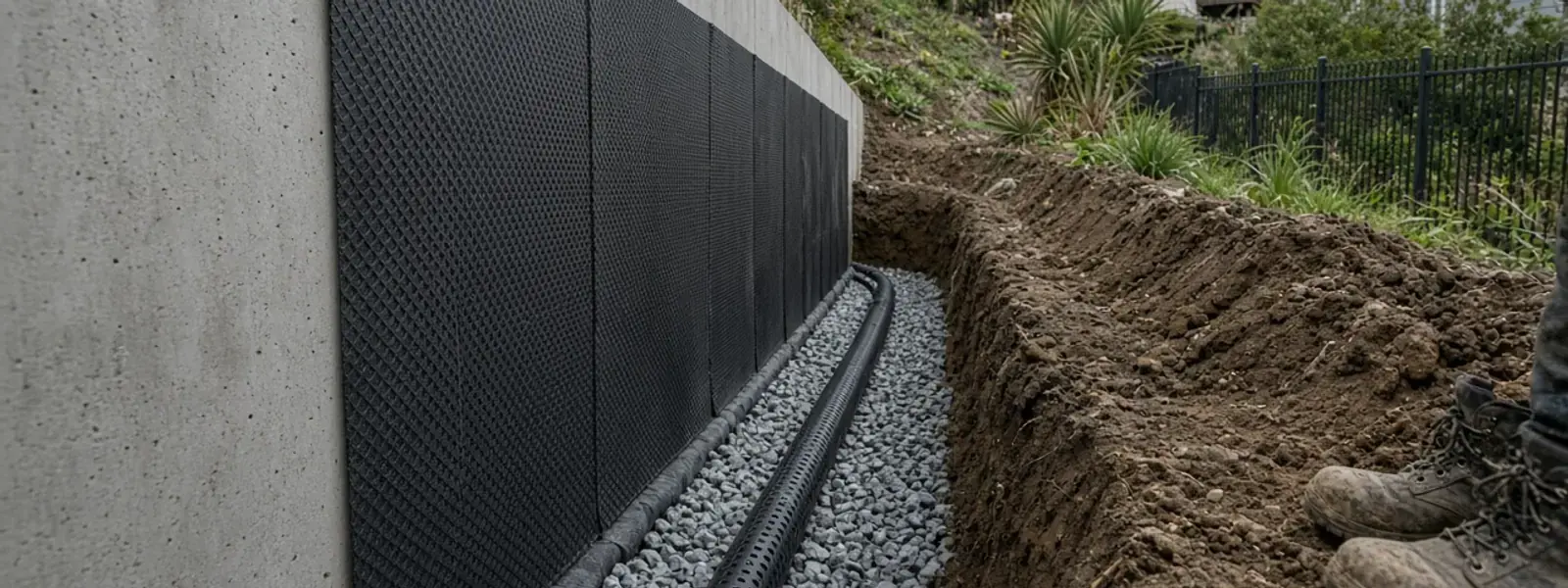
Retaining wall drainage is the system that keeps water from building up behind a wall: clean crushed rock, filter fabric, a perforated pipe that runs to a real outlet, weep holes where the wall allows them, and surface grading that sends rain away. San Fran Retaining Wall Pros installs drainage on new walls and adds it to existing ones, because water is the number one reason walls lean, crack and fail in San Francisco.
Why water is the real enemy of every retaining wall
Walls are usually designed for soil pressure. The design number is often called equivalent fluid pressure, and for a typical wall with free-draining backfill it's in the range of 35 to 45 pounds per cubic foot. Saturated clay behaves very differently. Add water and the pressure can double or more, and the extra load keeps climbing during long, wet storms.
Water also swells clay soils, freezes in colder climates, softens the base of the wall and washes soil out from under it. In the Bay Area, atmospheric rivers can drop several inches of rain in a day, on top of ground that's already wet from earlier storms. A wall that was fine in October can fail in February.
We don't call this extra credit. It's the foundation of everything. A wall without drainage is a wall betting against the weather.
A rule worth remembering
If water has no easy path out from behind a wall, it'll find a hard one, and the hard one is usually through the wall.
The parts of a proper drainage system
| Component | Purpose | Common specification |
|---|---|---|
| Drain rock | Gives water a fast path down and out | Clean, open-graded crushed rock, often three-quarter inch, or Class 2 permeable material where specified |
| Filter fabric | Keeps soil from clogging the rock | Nonwoven geotextile, wrapped on the soil side and over the top |
| Perforated pipe | Collects water and carries it away | Four inch rigid perforated pipe in a gravel envelope, laid with a continuous fall |
| Outlet | Where the water goes | Daylight outlet, storm drain connection or approved dispersal |
| Cleanouts | Let you flush the pipe later | Accessible risers at turns and ends |
| Weep holes | Relieve pressure through solid walls | Two to four inch openings at about six to eight foot spacing, set at the base |
| Surface drainage | Keeps rain from entering the backfill | Sloped soil, swales, catch basins and piped downspouts |
Each piece is cheap compared with a failed wall. And each is easy to leave out if nobody's checking.
The pipe is only as good as its outlet
The most common mistake we find is a perforated pipe that goes nowhere. It collects water, fills up and sits there. That's a long, narrow pond behind the wall.
- Pipe needs a continuous fall toward the outlet, usually at least one percent, which is about an eighth of an inch per foot
- The outlet has to be a real discharge point, like daylight on a lower slope, a dispersal area, or an approved connection
- Rodent screens or flap gates keep animals out of daylight outlets
- Cleanouts let you flush silt before it blocks the line
- Pipe goes in a gravel envelope, wrapped in fabric, so fines can't plug the holes
In San Francisco, where the water can go is a regulatory question as well as a design one. Much of the city is on a combined sewer system, and rules for connecting yard drains to the sewer, to street gutters or to dispersal areas vary by location. We check with the city before we pick an outlet.
Weep holes and drainage composites for tight spaces
Solid walls like poured concrete and block need an exit for water. Weep holes through the wall at the base do part of the job, backed by gravel on the soil side so they don't clog.
In tight spaces where there's no room for a thick layer of rock, a prefabricated drainage composite can do the work. These are sheets of dimpled plastic with filter fabric bonded to one side. They're placed against the wall and connect to a pipe at the base. They take up an inch or two instead of a foot. They're useful beside a house, a property line or another structure.
Composites aren't a cure-all. Over time, fabric can clog, and they move less water than a full rock zone. Where there's room, rock is still the preferred approach.
Surface water: the half most people forget
Even a perfect subdrain can be overwhelmed if the surface sends water behind the wall. We look at the entire slope and the roof above it.
- Downspouts piped to a safe outlet, not dumped at the wall
- Soil at the top of the wall sloped away from the face
- Swales or catch basins to intercept runoff from slopes and driveways above
- Irrigation kept well back from the wall, and drip used instead of spray
- Paving that drains away, not toward the wall
- Planting that holds soil without needing constant watering
Walls with a hillside above them benefit from an intercepting drain at the top that catches runoff before it reaches the wall. See our hillside walls page for more.
Adding drainage to a wall that's already built
A lot of walls get built without enough drainage. That's usually fixable, and often cheaper than rebuilding. The work depends on the wall type and what's behind it.
- Locate buried utilities and map the wall and slope.
- Excavate a trench behind the wall to the base, in sections so the wall isn't left unsupported.
- Install fabric, drain rock and a perforated pipe sloping to an outlet.
- Add weep holes if the wall is solid and doesn't have them.
- Backfill with free-draining stone and restore the surface.
- Correct surface grades and downspout discharge.
In some cases, a leaning wall needs more than drainage. If the wall has already moved, drainage will help prevent further movement, but it won't push the wall back. See our repair and replacement pages for the next step.
French drains, subdrains and interceptor drains
Terms get mixed up, so here's a plain version.
- Wall drain. Rock and pipe directly behind the wall
- French drain. A trench with rock and a perforated pipe that collects groundwater or surface water in a lawn or slope
- Interceptor drain. A drain placed uphill of a problem area to catch water before it reaches it
- Area drain or catch basin. A surface inlet that collects runoff from a paved or low area
- Horizontal drain. A long, nearly flat pipe drilled into a slope to relieve groundwater, used on larger hillside problems
Many sites need more than one. A wall with a wall drain, an interceptor drain above and a piped downspout is more resilient than one with only a single line.
Keeping drainage working
- Check outlets before the first big rain and after major storms
- Flush the line through cleanouts every year or two
- Look for wet spots, seeps or green growth at the base of the wall
- Clear leaves and debris from catch basins and swales
- Watch for new cracks, leans or bulges that could mean drainage has failed
- Keep irrigation off the slope above the wall
A drain that's working looks dull. Water trickles out of the outlet during storms, the soil above stays firm and the wall doesn't change. That's what we're after.
Retaining Wall Drainage FAQ
Does every retaining wall need drainage?
Almost every wall that holds soil does. Open systems like gabions and dry-stack stone drain through the face, but they still need fabric and a way to handle surface water. Solid walls need a drain, weep holes or both.
Where should the drain pipe go?
Along the base of the wall on the soil side, in a gravel envelope and wrapped in filter fabric, with a continuous slope to an approved outlet.
Can I add drainage to an existing wall?
Often yes. We can excavate behind the wall in sections, install rock, fabric and a pipe, add weep holes and fix surface grades. If the wall has already moved, we'll look at repair or replacement as well.
What are weep holes?
Small openings through the base of a solid wall that let water escape. They should be backed with gravel so they don't plug, and they need to be kept clear.
Can I connect a wall drain to the sewer?
Not always. San Francisco has rules about where yard drainage can go, and many areas are on combined systems. We check requirements before choosing an outlet.
How do I know if my wall's drainage has failed?
Signs include wet soil or seeps at the base, a wall that's started leaning or bulging, efflorescence on concrete or block, moss growth in odd places, and weep holes that never run during storms.
More retaining wall services
- Retaining Wall RepairLeaning, cracked, bulging or draining badly? We find the cause first, then repair the wall or tell you it needs replacing.
- Retaining Wall InstallationNew retaining walls built from the footing up, sized to the soil, the slope and the load sitting behind them.
- Gabion Retaining WallsWire basket walls filled with rock. Free draining, flexible, and a good fit for creek banks and rough access.
- Hillside Retaining WallsSoldier pile, tieback, soil nail and tiered systems for steep lots where a simple wall will not do.
Working outside San Francisco? See the full list of cities we work in, or browse all our retaining wall services.