The short answer
Retaining wall repair in San Francisco starts with finding out why the wall is moving, because patching a crack on a wall that's still being pushed will just give you a new crack. San Fran Retaining Wall Pros repairs leaning, bulging, cracked, settling and draining-poorly walls with crack injection, tiebacks, grouting, partial rebuilds and drainage corrections, and we'll tell you honestly when a wall is past repair.
Diagnose first, then repair
Walls rarely fail for one reason. A wall that's leaning might have a footing that's too small, soil behind it that's saturated, a clogged drain, a driveway load nobody planned for, or all four. A repair that fixes the symptom and ignores the cause is a repair that comes back.
A proper evaluation looks at the wall from both sides. We measure lean with a level or plumb line and note which direction and how far. We map cracks and measure widths with a crack gauge. We check the base for settlement or soil loss, the face for efflorescence (the white crust that shows water is moving through), the top for displacement, and the ground above for signs of cracks, scarps or new low spots. Then we look at where the water goes.
The goal of that first visit isn't a sales pitch. It's a decision about whether the wall can be stabilized, needs a structural repair, or has outlived its design and should be replaced.
Warning signs that a retaining wall is failing
Some failures are dramatic. Most start quietly. Here are the signs we see most often on Bay Area walls, and what each one usually means.
| What you see | What it often points to | How urgent it feels |
|---|---|---|
| Wall leaning forward | Overturning or sliding from soil pressure, weak footing or water behind the wall | High, especially if it's getting worse |
| Horizontal cracks | Bending in the wall from too much pressure or too little steel | High |
| Stair-step cracks in block | Differential settlement or movement at mortar joints | Medium to high |
| Vertical cracks | Shrinkage or settlement, sometimes harmless, sometimes not | Low to medium, needs checking |
| Bulging face | Soil and water pressure pushing the middle of the wall out | High |
| White crust on the face | Water moving through the wall, often a drainage problem | Medium |
| Water running out the base only in storms | Drains working but overwhelmed, or weep holes partly blocked | Medium |
| Soil or gaps at the base | Erosion in front of the wall, or settlement | Medium to high |
| Fence or stair above tilting | The retained soil is moving | High |
A single hairline vertical crack in a concrete wall can be shrinkage and nothing more. A horizontal crack that opens a little more each winter is something else. The difference is hard to judge from the street, so it's worth a look.
The repair methods that actually work
What fixes a wall depends on what's wrong with it. Here are the methods we use and when each makes sense.
Crack repair: epoxy and polyurethane injection
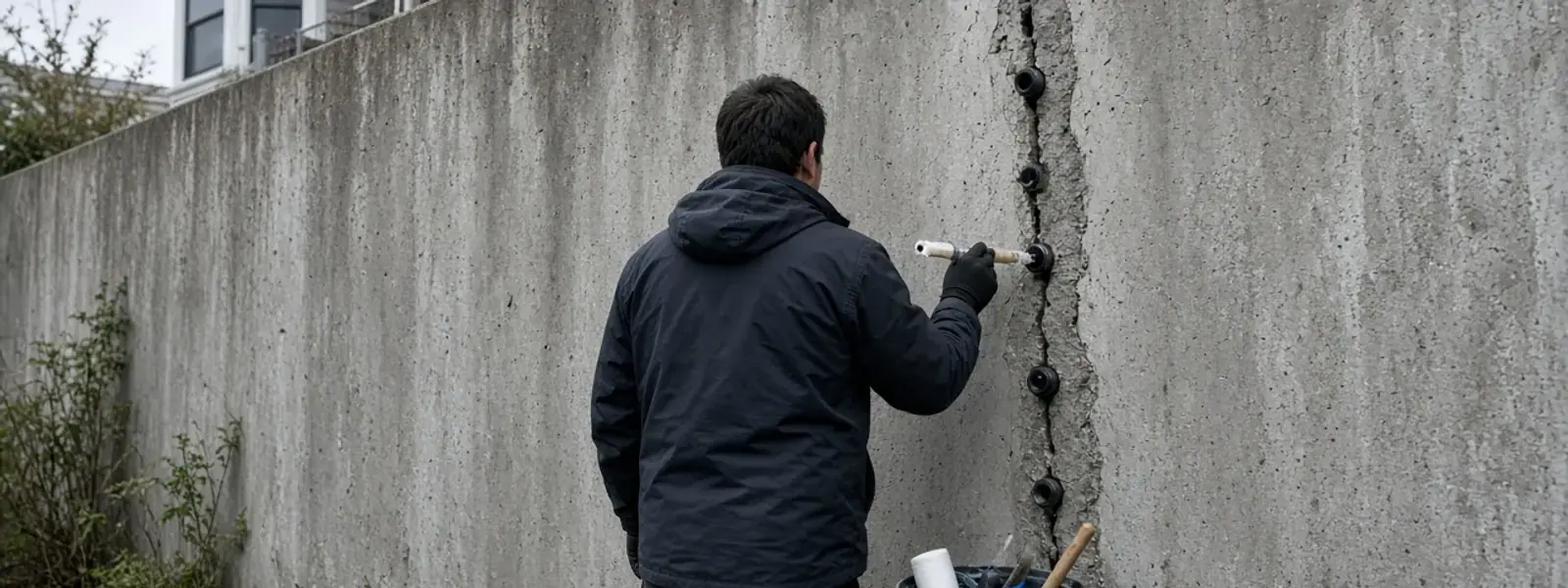
Structural cracks in concrete can be bonded with low-viscosity epoxy injected under pressure through surface ports, which restores some of the section's strength. Cracks that leak or move seasonally are often better with flexible polyurethane, which seals without locking the crack rigid. The wall's movement has to be stopped first, or the crack will reopen beside the injected one.
Drainage correction
Many wall problems are water problems. Clearing blocked weep holes, replacing a crushed or silted drain pipe, adding an outlet, installing an interceptor drain above the wall or regrading to keep surface water off the slope can all reduce the load enough to stabilize a wall. This is often the cheapest repair and the one with the best payoff, and it's covered in more detail on our retaining wall drainage page.
Tiebacks and helical anchors
When the soil load is more than the wall can handle, tying the wall back into stable soil can help. Helical anchors are steel shafts with helical plates, screwed into the ground at an angle behind the wall, connected to a plate or waler on the wall face and tensioned. Grouted tieback anchors do the same job in firmer ground or rock. Both need design by an engineer, because the anchor has to sit beyond the failure zone to work.
Grouting and reinforcing masonry
Block walls with ungrouted cells or missing steel can sometimes be improved by drilling and grouting voids, adding steel in core cells, or installing surface-mounted carbon fiber straps to resist bending. Carbon fiber straps work well for bowed walls where excavation isn't possible, but they don't fix a drainage problem or a footing that's moving.
Partial rebuilds and facing replacement
If the lower section of a wall is sound and the upper part has failed, rebuilding the damaged section can make sense. Segmental block walls can often be taken down in sections, the reinforced zone re-compacted with new geogrid, and the block restacked. A bowed timber wall might be saved by replacing a few rotted boards and adding deadmen. A failed face on an otherwise solid concrete wall can be repaired with a bonded overlay.
Shoring while you work
Repairs on walls that are already moving are risky. Temporary shoring, such as timber braces, screw jacks or raker braces, can hold a leaning wall in place while soil is excavated and drainage is installed. Never dig behind a wall that's moving without shoring. It's one of the most common ways a repair becomes an emergency.
Repair or replace: how we decide
The cost and effort of a repair compared to a rebuild depends on how much of the wall is still doing its job. A good rule of thumb is that if the footing is sound and the problem is in the upper section or in the drains, repair is worth looking at. If the footing has rotated or slid, if the steel has corroded badly, if the wall was built without drainage or reinforcement and the cracks are everywhere, replacement usually gives a better long-term outcome.
- Repair makes sense when the wall is mostly plumb, the cracks are limited and stable, and the main problem is water
- Repair plus anchors makes sense when the wall is sound but under-designed for the soil load
- Replacement makes sense when the footing has failed, when the wall is made of rotted timber or crumbled block, or when you're adding load that the old design never considered
- Replacement also makes sense when repairing costs nearly as much as a new wall that's built right
We give you the choices and the reasons in plain language. If you want a second opinion on a quote from someone else, we're happy to look at the wall and tell you what we see.
When a wall is moving right now
If a wall is actively failing, with soil falling, a fence leaning in days rather than months, or water pouring through the face, keep people and cars away from the base and the high side. Don't try to prop it up yourself. Take photos, note the date and time, and call. In a real emergency involving a structure, call 911 first.
Emergency work usually means shoring or buttressing the wall, diverting water with temporary pumps or tarps, and removing load from the top of the slope. A permanent repair or replacement design follows once things are stable. A winter storm sequence is a common trigger, because saturated soil plus runoff finds every weakness in a wall.
Repair notes by wall type
Concrete walls
Look at crack pattern and width, rust staining (which means the steel is corroding), spalling at the surface and any efflorescence. Corroded steel needs the concrete cut back, the bars cleaned or replaced and the section patched with repair mortar. Sealing the surface alone just traps moisture.
Block and CMU walls
Mortar joints show stress first. Stair-step cracking along the joints suggests settlement or rotation. Horizontal cracking at mid-height suggests bending. Walls with no steel in the cores are common in older yards and often need strengthening or replacing.
Timber walls
Check posts at ground level, where rot usually starts. A screwdriver that sinks into the wood tells you everything. Timber walls typically have a shorter service life than masonry, so repairs buy time rather than ending the story. Our wood retaining wall page covers lifespans and when to rebuild.
Stone, boulder and gabion walls
Dry-stack and boulder walls often only need a few displaced stones reset and drainage cleared. Gabion walls need a check of the wire for corrosion and broken lacing, and a look at the rock fill for settling. They're forgiving walls, which helps.
Retaining Wall Repair FAQ
Can a leaning retaining wall be fixed, or does it have to be replaced?
Sometimes it can be fixed. If the footing is sound and the lean comes from water pressure or a shallow design problem, drainage fixes, tiebacks or partial rebuilds can stabilize the wall. If the footing has rotated or the wall has sheared, replacement is usually the better route. A site visit tells us which.
Are cracks in my retaining wall dangerous?
Not always. A fine vertical crack can be shrinkage. Horizontal cracks, stair-step cracks, cracks that keep widening and cracks with displacement on either side need attention. Take dated photos so you can tell whether it's changing.
What causes a retaining wall to bulge?
Usually water and soil pressure pushing on the middle of the wall. Poor drainage, missing reinforcement and a design that didn't expect the load all contribute. A bulge is a sign that the wall is working harder than it should.
Do you repair walls someone else built?
Yes. Most repair work is on walls that were built by someone else, sometimes decades ago. We'll look at what's there, how it was built, and what's practical to fix.
Do repairs need a permit?
Structural repairs, anchors and rebuilds on walls over the permit threshold often do. Maintenance such as clearing drains typically doesn't. We check with your local building department before starting structural work.
Will fixing the drains alone solve the problem?
Sometimes. If the wall is mostly sound and water is the main load, drainage corrections can make a big difference. If the wall is already rotating or cracked through, drains help but may not be enough on their own.
How soon can someone look at my wall?
Call and tell us what's happening. If the wall is moving or something is threatened, tell us that up front so we can treat it with the urgency it needs. Otherwise we'll set up a visit that works for your schedule.
More retaining wall services
- Retaining Wall ReplacementWhen repair makes no sense, we remove the failed wall, deal with why it failed, and build a replacement sized for the real loads.
- Retaining Wall DrainageFrench drains, weep systems, waterproofing and outlets that stop water from loading your wall.
- Concrete Retaining WallsCast-in-place reinforced concrete walls with real footings, board-formed or smooth, for tall cuts and tight lots.
- Cinder Block Retaining WallsReinforced, grouted CMU walls for backyards and side yards, finished in stucco, paint, stone veneer or left raw.
Working outside San Francisco? See the full list of cities we work in, or browse all our retaining wall services.