The short answer
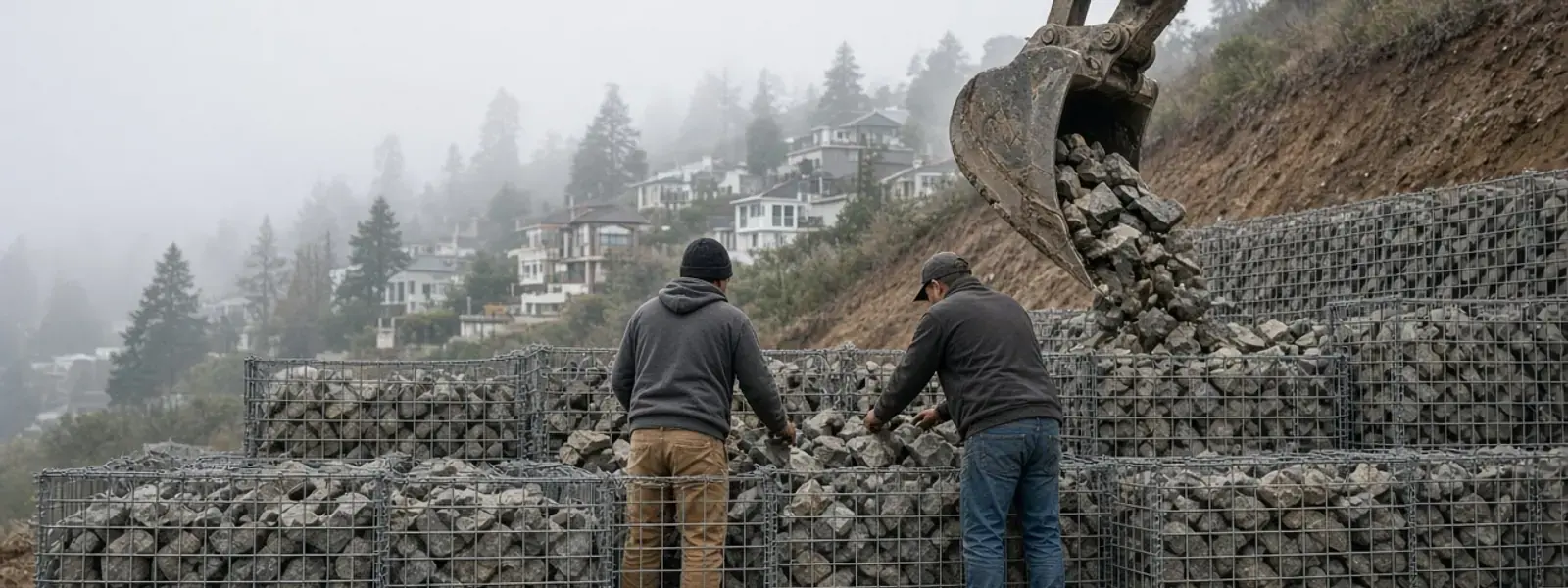
Gabion retaining walls in San Francisco are stacked wire baskets filled with hard, angular rock. They drain on their own, tolerate some settling and look modern. San Fran Retaining Wall Pros builds gabion walls with the right coating for coastal air, a compacted base, a lean back into the slope and filter fabric behind the baskets, so the rock stays put and the soil stays behind it.
What a gabion wall is and how it holds soil
A gabion is a wire cage, usually box-shaped, filled with stone. Stack enough of them in rows, tie them together and you have a wall. Each basket is heavy, and together they act as a gravity wall. The weight of the rock holds back the soil, and the wire holds the rock in a neat shape.
Gabions started as an engineering tool for rivers, roads and slopes. They've since moved into residential yards because they look good, they're relatively quick to build and they solve a problem other walls struggle with, which is water. A gabion wall is open. Water passes straight through it, so pressure can't build up behind the wall.
That openness is the main reason we recommend them on wet slopes, near seeps and at the base of hillsides that collect runoff.
Wire, mesh and coatings, and why coastal air matters
The cage matters as much as the rock. A gabion that rusts through in ten years is a pile of rock with a mess of wire around it.
| Type | Description | Best use |
|---|---|---|
| Welded wire mesh | Straight, rigid panels with square openings, galvanized or coated | Clean modern faces, garden walls, planters, screens |
| Double-twist woven mesh | Hexagonal mesh in a flexible, interlocking weave | Heavier engineering work, uneven ground, slopes |
| Galvanized steel | Zinc coating on the wire | Dry inland conditions |
| Zinc-aluminum alloy coating | Often sold as Galfan, with better corrosion resistance than plain zinc | Most Bay Area projects |
| PVC over alloy coating | An extra polymer layer over the wire | Salt spray, wet soil, coastal and creek-side sites |
In San Francisco, Pacifica and Sausalito, fog and salt spray eat uncoated steel. We steer coastal clients toward alloy-coated or PVC-coated baskets, and we're honest that no coating lasts forever. The wire is the weak link, which is why quality of the basket is one of the first things to ask about.
Choosing the fill rock
The rock is half the look and most of the strength. Good gabion stone is hard, durable, angular and sized so it can't fall through the mesh.
- Size. Usually four to eight inches, bigger than the mesh opening and small enough to pack tightly
- Hardness. Quarry rock like granite, basalt or hard sandstone, not soft shale that crumbles
- Shape. Angular stone locks together. Round stone shifts and settles
- Color. Gray, tan, rust and charcoal are all available, and the color changes with the light
- Cleanliness. Fines wash out and stain, so washed rock is worth it
A basket three feet on a side holds roughly two thousand pounds of rock, depending on the stone and how tightly it's packed. Fully packed gabion walls often run around a hundred pounds per cubic foot. That's heavy, and it's why the base matters so much.
How we build a gabion wall
- Excavate for the base and level it, with a compacted gravel pad that's wider than the baskets.
- Set the bottom row of baskets, wire them together at every edge and stretch them so the faces are straight.
- Fill the baskets in lifts, placing the face stones by hand for a tight look, then filling the back with machine-placed rock.
- Install internal ties, usually cross-ties between the front and back panels, so the face can't bow out as rock settles.
- Close the lids and wire them down to the basket below.
- Set the next course back slightly so the wall leans into the slope.
- Line the soil side with nonwoven filter fabric so fines can't migrate into the rock.
- Backfill with free-draining stone, and grade the top so runoff doesn't pour over the wall.
A good gabion wall has flat, plumb-looking faces, crisp corners and no bulging. Bulging comes from baskets that weren't tied, rock that was dumped in instead of placed, and a base that settled. All three are preventable.
Height, step-back and engineering
Gabion walls are gravity walls, so they need to be wide in proportion to their height. A common approach is to step the baskets back as the wall rises, with a base about half to two-thirds as wide as the wall is tall. That's why a six foot gabion wall is often two or three baskets deep at the base.
Residential gabion walls are usually three to six feet high. Taller ones are possible with engineering, sometimes with geogrid tied into the baskets for greater strength. A wall that's four feet or taller from the bottom of the footing to the top, or one that supports a driveway or building, generally needs a permit and engineered drawings. We coordinate that.
Where gabions earn their place
- Wet slopes and seeps. The open structure lets water through and keeps pressure from building
- Creek and swale edges. Rock fill resists erosion and handles flow better than solid walls
- Modern landscapes. The clean lines pair well with contemporary architecture
- Seat walls and planters. The same baskets can be topped with wood or concrete for seating
- Fire-conscious yards. Steel and rock don't burn
- Noise and privacy screens. Taller, free-standing gabion panels block sound and sightlines
Where gabions are a poorer fit: tight spaces where a thick base isn't an option, and locations where you want the smallest possible footprint. A concrete or reinforced block wall is much thinner. For a more natural look, see our boulder walls.
How gabions age
Gabions look different over time. Moss and lichen grow on the rock. Plants root in the gaps and soften the face. In coastal fog, the wire can streak with rust if it's not coated. Soil can wash into the voids if the fabric wasn't installed right.
Maintenance is light. Check baskets for broken wires or bulging faces after big storms. Clear plants that are growing aggressively through the rock. Keep irrigation and downspouts pointed away from the wall. If a basket looks damaged, it's a quick repair compared with most wall types.
Gabion vs boulder vs poured concrete
| Concern | Gabion | Boulder | Poured concrete |
|---|---|---|---|
| Water pressure | Excellent, open and free-draining | Good, with fabric | Needs designed drainage |
| Footprint | Wide | Wide | Narrow |
| Look | Modern, stacked-rock | Natural, rugged | Smooth or formed |
| Needs heavy equipment | Sometimes, hand-fill is possible | Almost always | Concrete delivery |
| Tolerates settlement | Yes, flexible | Yes, flexible | Limited |
| Coastal air | Needs the right coating | Excellent | Good with proper cover |
Gabion Retaining Walls FAQ
How long do gabion walls last?
That depends on the wire coating and the environment. Alloy-coated and PVC-coated baskets last longer than plain galvanized, especially in coastal air. The rock itself lasts indefinitely, so the wire is the thing to watch.
Do gabion walls need drainage?
They're naturally free-draining, which is their main advantage. We still add filter fabric on the soil side so fines can't wash into the rock, and we direct surface water away from the top.
How tall can a gabion wall be?
Residential gabion walls are commonly three to six feet. Taller walls are possible with a wider base, geogrid and engineering.
Can gabions be used as a fence or screen?
Yes. Free-standing gabion panels work as privacy and noise screens, and they're often used alongside retaining walls in modern landscapes.
Do gabion walls need a permit?
Walls over four feet from the bottom of the footing to the top, or walls supporting a surcharge, generally do. We check with your local department and handle the process.
Will animals nest in the rock?
Small animals can find gaps in any rock wall. Tight packing and sized stone reduce the openings. Some people like the wildlife habitat. Others want a tighter fill, which we can discuss.
More retaining wall services
- Boulder Retaining WallsLarge rock walls placed with an excavator, set into a keyed base and drained like any other engineered wall.
- Retaining Wall DrainageFrench drains, weep systems, waterproofing and outlets that stop water from loading your wall.
- Hillside Retaining WallsSoldier pile, tieback, soil nail and tiered systems for steep lots where a simple wall will not do.
- Stone Retaining WallsDry-stack and mortared stone walls built with proper footings, batter and drainage, not just a pretty face.
Working outside San Francisco? See the full list of cities we work in, or browse all our retaining wall services.