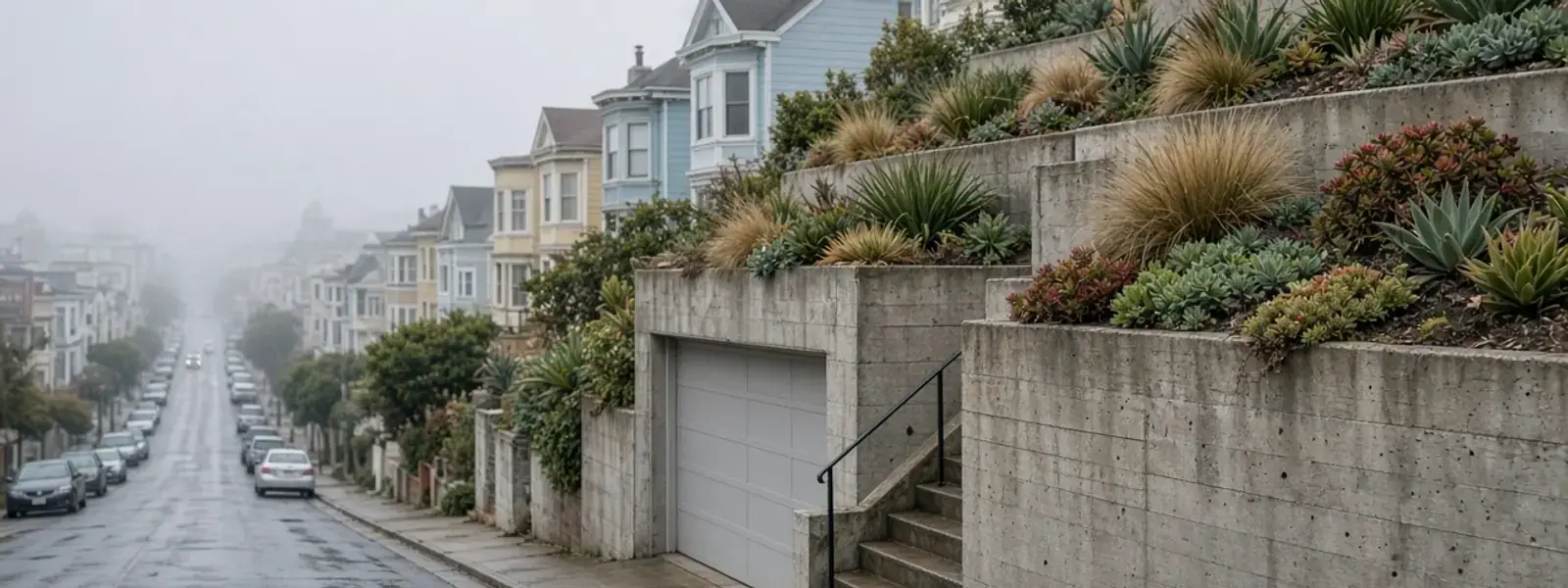
Plenty of Bay Area back yards are more slope than yard. A good set of retaining walls can turn that slope into level patios, garden beds and play space. San Fran Retaining Wall Pros helps with these projects often, and here's how the thinking goes.
One tall wall or several short ones?
On a slope, you can build one tall wall to create a big flat area, or two or three shorter walls with terraces in between. Both work. Each has tradeoffs.
| Question | One tall wall | Tiered terraces |
|---|---|---|
| Flat area created | One large level space | Several smaller levels |
| Engineering | Usually required | Often easier per wall |
| Look | Big face | Softer, more garden-like |
| Space needed | Less width | More width |
| Drainage | One big drain | Drain at each wall |
Tier spacing: the rule people miss
If two walls are too close together, the upper wall loads the lower one, and they act like one tall wall. A common rule of thumb is to keep the distance between the base of the upper wall and the face of the lower wall at least twice the height of the lower wall.
A four foot lower wall needs about eight feet of terrace in front of the upper one. That shapes how many tiers will fit in a yard.
Picking materials for terraces
- Interlocking block is a good fit for curved, tiered walls with room behind
- Stone gives a natural look and can be dry-stacked at lower heights
- Reinforced block or concrete works where space is tight or walls are tall
- Boulder suits big lots with machine access
- Timber is a low-cost option for short, simple walls
Drainage on every tier
Each wall needs its own drain. Water that collects behind the upper wall can end up behind the lower one. Surface drains, swales and piped downspouts should handle the runoff from above.
A terrace is also a place where water can sit. Grade each level slightly toward a drain so it doesn't pond against the next wall.
Using the space you create
- Patio or seating area with a low seat wall
- Raised planting beds for vegetables, herbs or natives
- A level lawn or play area
- Fire pit with a built-in bench
- Steps built into the wall
- Lighting built into caps or risers
Think about where water, sun and access are. A flat terrace at the bottom of a slope can end up soggy if the drainage isn't right.
Planting the slope
Roots hold soil. Deep-rooted natives like ceanothus, coyote brush, sage and native grasses are good for slopes. Mulch helps keep soil moist and reduces splash erosion. Avoid heavy irrigation near the top of any wall.
Phasing a bigger yard project
Not every yard has to be done at once. A multi-tier project can be phased so you get a usable space sooner, and so the budget stretches over seasons.
- Fix drainage and any failing wall first, since that protects everything else.
- Build the lowest and most important wall and terrace next.
- Add upper tiers as budget allows, with the grading and drains planned from the start.
- Leave planting and finishes for last, once the walls are settled.
The trick is to plan the whole yard on paper first, so the early phases don't have to be torn up for the later ones.
A Marin example
Steep, wooded lots like those in Mill Valley often combine walls, stairs and planting, and have to work around redwoods and creeks. Planning the layout around roots and drainage first makes the rest easier.
Related services
Written by the San Fran Retaining Wall Pros Team. Published November 6, 2026, updated November 9, 2026.