The short answer
Retaining wall replacement in San Francisco means removing a wall that's failed or is too far gone to repair, working out why it failed, and building a new one with a proper footing, reinforcement and drainage. San Fran Retaining Wall Pros handles shoring, demolition, haul-off, new footings and the rebuilt wall in concrete, block, stone, timber or gabion, sized to the loads the old wall never planned for.
Why retaining walls fail in the first place
Replacing a wall without understanding why it failed is how you end up replacing it twice. Almost every failed wall we see has one or more of the same root causes.
- No drainage, or drainage that was installed and then clogged with silt or crushed by backfill
- A footing that's too narrow, too shallow, or sitting on loose fill or uncompacted soil
- Not enough steel, or steel in the wrong place, or no steel at all in a masonry wall
- Timber that's rotted at the base, especially treated posts that weren't rated for ground contact
- A wall designed for a level yard that now holds a sloped backfill, a driveway or a new building addition
- Roots, burrowing animals, irrigation lines or downspouts that changed the water picture
- Earthquake shaking on a wall that was never designed for it
A lot of walls in the city were built by owners and handymen decades ago, with the best of intentions and no engineering. Some have lasted remarkably well. Others had a limited lifespan from day one. When one of those walls starts to move, replacement is often the right call.
Signs that replacement beats repair
Our repair page covers the situations where fixing makes sense. These are the ones where it usually doesn't.
- The wall has rotated at the base or slid forward, which means the footing has failed
- Multiple posts in a timber wall are rotted through
- Cracks run through the full thickness of a masonry or concrete wall in several places
- The steel is badly corroded or was never there
- The wall leans more than a few percent of its height and is still moving
- The wall can't be economically brought up to current design standards for the load it carries
- You're changing the site, with a new ADU, a driveway, a pool or an addition, and the old wall won't carry the new load
Replacement also gives you a chance to change the wall type. A failed timber wall might become a reinforced block or concrete wall, and a failed stack of stones might become a segmental block system with geogrid. We talk through the trade-offs so you aren't repeating the same mistake in a new material.
How a replacement project goes, step by step
- Evaluate the old wall and the soil behind it, and work out the failure cause.
- Design the new wall, with an engineer where the height, the load or the permit calls for it.
- Pull permits and schedule utility locates. USA North 811 gets called before any digging.
- Shore or buttress the old wall if it's still holding anything that matters, like a structure or a neighbor's fence.
- Demolish the old wall in controlled sections, working from the top, sorting concrete, block, timber and steel for disposal or recycling.
- Remove failed fill and soft soil below the footing line, and prepare a compacted subgrade or an engineered base.
- Build the new footing, reinforcement and wall, with inspections at the stages the permit requires.
- Install waterproofing, drainage composite, perforated pipe and filter fabric, and daylight the outlet.
- Backfill with free-draining material in thin lifts, compacted properly, and regrade the surface so water leaves instead of arriving.
- Cap the wall, finish it, and restore the area above and below.
Demolition, access and what to do with the old wall
Taking down a retaining wall isn't like knocking down a garden shed. The wall might be holding up soil that's been compacted for decades, and removing it can release that soil. Contractors typically work from the top down, in sections, with the next section supported as the old one comes out.
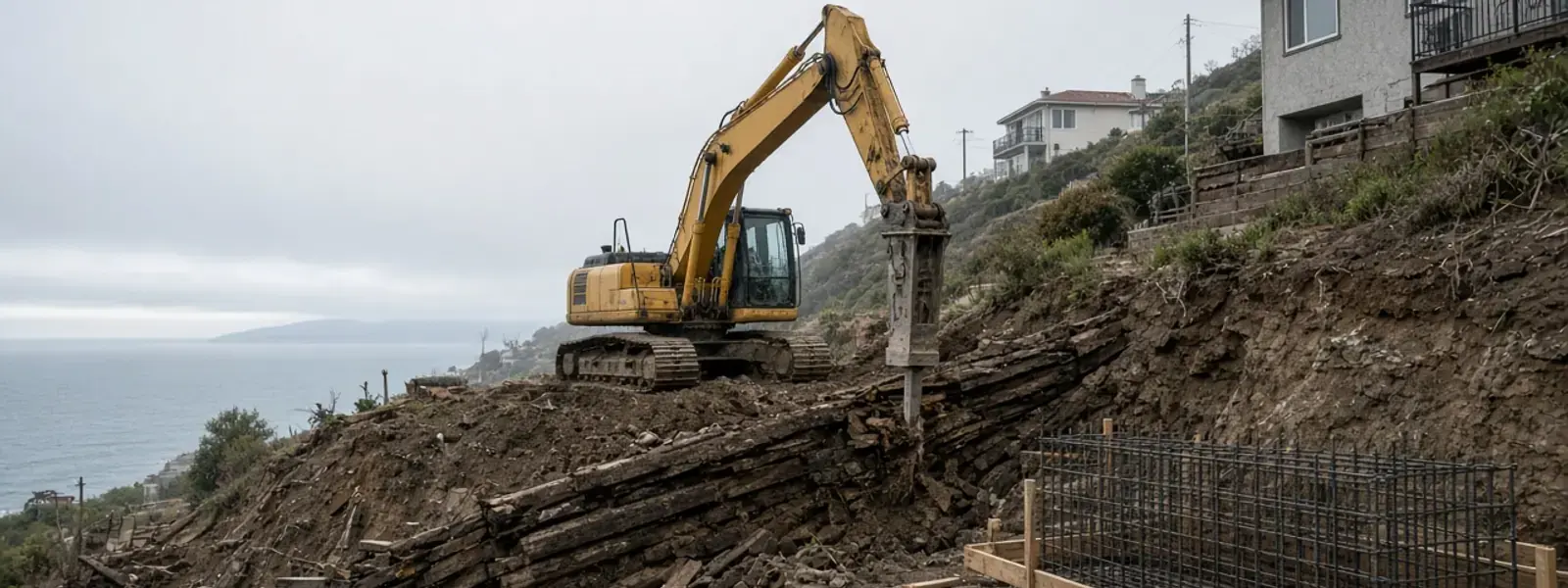
Access decides the method. In an open backyard, a mini excavator with a hydraulic breaker can take out concrete in an afternoon. On a stairs-only San Francisco lot, the same wall might come out by hand with jackhammers, pry bars and wheelbarrows, hauled in sacks to a dump truck at the curb. Timber walls come apart more easily, but creosote-treated ties need to be handled and disposed of according to the rules for treated wood.
Concrete and block can often go to a recycling facility instead of a landfill. Steel gets pulled and recycled. Soil that's clean can sometimes be reused behind the new wall after it's been checked, and soil that's contaminated, soft or full of organic material needs to go. We sort and plan this up front so there aren't surprises on the invoice.
Designing the new wall for the loads it will actually see
Replacement is the best time to get the design right. That starts with an honest inventory of what the wall holds up and what sits on top of it.
- Wall height, measured from the bottom of the footing, not just the visible face
- Slope of the ground behind the wall, level or rising
- Any surcharge above the wall: a driveway, parked cars, a building footing, a pool, a pile of soil
- Water: seasonal, groundwater, irrigation, roof runoff
- Soil type and strength, and whether the base is native soil or fill
- Seismic loads, which are required in California design
Some replacement walls end up taller or wider in the footing than the old one, because the old one was under-designed. Some end up shorter, because regrading the slope above reduces the load. The new design should match the real situation, not what the wall used to be.
Walls and neighbors
If the wall sits on or near a property line, talk to the neighbor before demolition. Removing a wall can release soil onto or from their property, and a replacement footing might need to extend toward the line. A short, friendly conversation and a written note beats a long dispute.
Choosing a material for the replacement wall
You don't have to rebuild what you had. Here's how the main options compare when you're replacing a failed wall.
| If the old wall was | Common replacement | Why |
|---|---|---|
| Rotted timber | Reinforced block or interlocking block | Longer service life, no rot, can be engineered for the load |
| Unreinforced block | Cast-in-place concrete or properly reinforced CMU | Steel and footing designed for the load and earthquake forces |
| Stacked stone with no drainage | Stone with a footing and drain, or segmental block with a stone veneer | Keeps the look with real structure behind it |
| Failed boulder wall | Boulder with a keyed base and filter fabric, or gabion | Better base and drainage |
| A wall on a very steep or moving slope | Soldier pile and tieback | Reaches stable ground below or behind the failure zone |
Timing, access and getting the most out of the rebuild
Replacements go best in the dry months, from late spring through early fall, because open excavations and fresh footings don't enjoy a storm. That said, walls don't fail on a schedule, and sometimes the project starts in winter with emergency shoring and finishes after the rains.
While the area's open is the time to fix other problems. Move irrigation lines, replace a leaking downspout, install sleeves for future wiring or drains, add steps, improve the surface grading. It's cheaper to do those once than to open the ground twice.
Ask for the scope in writing: wall type, height and length, footing details, reinforcement, drainage elements, finish, haul-off, and what's not included. A good scope spells everything out. A bad one is a single line with a number at the end.
We serve homeowners across San Francisco and the surrounding bay communities. You can see where we work on our cities page.
Retaining Wall Replacement FAQ
How do I know my retaining wall needs to be replaced?
Look for a footing that has rotated or slid, rot through multiple timber posts, through-wall cracks in masonry, corroded or missing steel, and ongoing lean. If repair would cost close to a new wall that's built right, replacement usually makes more sense.
Can you reuse the old wall's materials?
Sometimes. Clean, sound block, stone or boulders can be cleaned and reused. Rotted timber, crumbled concrete and bent steel can't. We sort what's worth keeping before demolition so you know what to expect.
Will the replacement wall be taller or wider than the old one?
It depends on the design. Many old walls were under-built, so the new footing or section may be bigger. Others get shorter after the slope above is regraded. The goal is a wall that matches the real load.
Do I need a permit to replace a wall?
Often yes, especially if the wall is more than four feet tall, supports a surcharge or a structure, or sits in a hazard zone. We find out what your city requires before we price the work.
What about my neighbor's side?
If the wall is on or near a property line, we recommend talking to the neighbor first. Demolition and new footings can affect their grade and fences. We can help document existing conditions before work starts.
Can you replace a wall in winter?
Yes, with care. Winter replacement is common when a wall has failed during a storm. Work is staged around rain, with erosion control and shoring in place, and some steps like backfilling wait for drier days.
What if the old wall is holding up part of my house?
That needs an engineer before anyone touches it. Temporary shoring is designed and installed first, and the new wall is built to carry the structure's load. We don't take walls like that apart on a hunch.
More retaining wall services
- Retaining Wall RepairLeaning, cracked, bulging or draining badly? We find the cause first, then repair the wall or tell you it needs replacing.
- Concrete Retaining WallsCast-in-place reinforced concrete walls with real footings, board-formed or smooth, for tall cuts and tight lots.
- Interlocking Block Retaining WallsSegmental block walls with geogrid reinforcement, the common choice for tiered yards and curved patios.
- Retaining Wall DrainageFrench drains, weep systems, waterproofing and outlets that stop water from loading your wall.
Working outside San Francisco? See the full list of cities we work in, or browse all our retaining wall services.