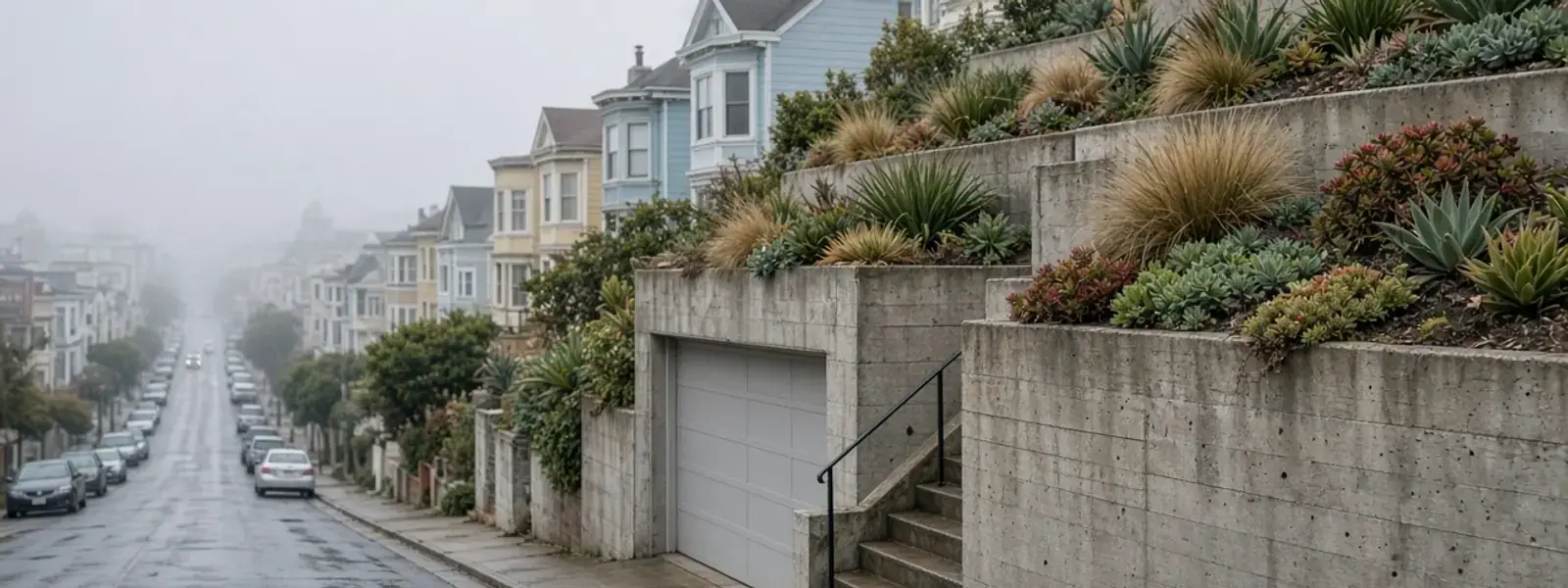
Every winter, the calls start the same way. The wall was fine in October. Then a big storm rolled in from the Pacific, and now it's leaning. At San Fran Retaining Wall Pros, we hear that story a lot, and the cause is almost always the same thing: water the wall was never built to handle.
What an atmospheric river does to a slope
An atmospheric river is a long, narrow band of moisture that drags warm, wet air across the Pacific and dumps it on the coast. For the Bay Area, that can mean several inches of rain in a day or two, often after earlier storms have already soaked the ground.
Soil can hold a lot of water, but only up to a point. Once the pores are full, the rest runs off the surface or soaks toward the lowest point. For a hillside lot, the lowest point is often right behind your retaining wall.
Why water multiplies the load on a wall
Engineers design walls around an equivalent fluid pressure, a number that represents how hard the soil pushes. For a typical wall with free-draining backfill, the design value is somewhere around 35 to 45 pounds per cubic foot. Water doesn't behave like soil. A saturated backfill pushes much harder, and standing water adds its own weight on top.
The result is that a wall designed for dry soil can see load double or more when the backfill is soaked. That extra load acts near the base of the wall, which is the worst place for it, because it tries to rotate or slide the whole thing.
Clay makes it worse
Many Bay Area slopes are clay-rich. Clay holds water for a long time, swells when wet and pushes sideways as it expands. Every storm adds to the load, and the soil takes weeks to drain.
Why so many walls have no drainage at all
Older walls, especially mid-century block and timber walls, were often built with soil pushed right up against the back and no drain. It worked for years because the ground was dry or because the wall was short enough to stay put.
- No gravel layer behind the wall, so water has no easy path down
- No perforated pipe, or a pipe that dead-ends with no outlet
- Clay used as backfill, which holds water instead of releasing it
- No weep holes in solid concrete or block walls
- Surface water from roofs, driveways and slopes pointed right at the wall
And even walls that started with good drainage can lose it. Pipes crush, outlets get buried and fabric clogs with silt over decades.
Early signs that a wall is struggling
- A wall that's slowly leaning forward, even by an inch
- Horizontal cracks in block or concrete, often near the middle of the wall
- Bulging between posts on a timber wall
- White, chalky streaks on concrete or block, called efflorescence, where water is moving through
- Wet soil, moss or green growth at the base of the wall
- Gaps opening between the top of the wall and the soil behind it
- Cracks in a patio or slab uphill of the wall
None of these automatically mean the wall is about to fall down. But they all say the same thing: water is winning. The earlier you catch it, the more options you have.
What actually helps
- Move water away before it reaches the wall. Pipe downspouts to a safe outlet, slope soil away from the wall and keep irrigation back from the top.
- Add or repair the drain behind the wall. Clean crushed rock, filter fabric and a perforated pipe running to a real outlet do most of the work.
- Make sure weep holes are open and set at the base of solid walls.
- Replace clay backfill with free-draining rock if you're rebuilding.
- Check the wall after storms, not just before them.
Our drainage page goes through each part in more detail.
A fall checklist before the first storm
You don't need a contractor for most of this. An hour with a ladder and a flashlight in October can catch the things that turn a rainy week into a repair bill.
- Walk the wall and look at every weep hole. Poke a stick in each one to make sure it's open.
- Find the drain outlet, if there is one, and clear leaves and silt from it.
- Check that every downspout empties well away from the wall, ideally into a pipe.
- Look at the soil above the wall. It should slope away, not toward the face.
- Turn off or reduce irrigation near the top of the slope.
- Take dated photos of any cracks, so you can compare after the rain.
- Move planters, firewood and storage off the top of the wall.
During a storm, look at the outlet. Water running out of it is a good sign. A dry outlet during heavy rain can mean the pipe is blocked.
A note for coastal lots
Pacifica and the coastal edge of the peninsula get hit the hardest. Steep sandy slopes, fog drip and heavy winter rain combine to saturate the ground. Our Pacifica page covers what we see there and how we plan walls for it.
Related services
Written by the San Fran Retaining Wall Pros Team. Published October 12, 2026, updated November 2, 2026.