The short answer
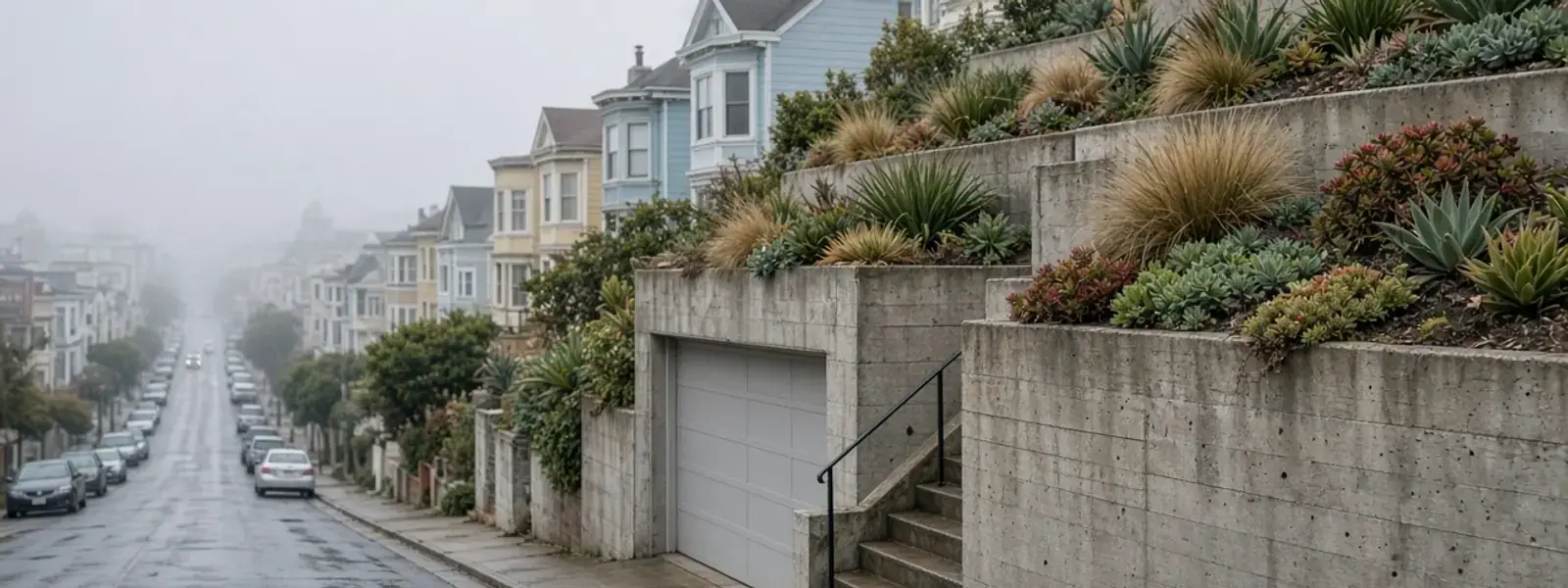
Retaining walls in Millbrae mostly serve the hill neighborhoods west of El Camino Real, where mid-century homes sit on benched lots above the bay. San Fran Retaining Wall Pros builds and repairs walls in Millbrae with deep footings, steel and drainage that suits clay-rich hillside soil and a lot of winter rain.
Millbrae's hills and flats
East of El Camino Real, Millbrae is flat and close to the airport. West of it, the ground climbs. Hillcrest, Meadow Glen, Mills Estate, Spring Valley and the Millbrae Highlands have winding streets, view lots and homes tucked into the slope.
Most of the homes were built in the 1940s through 1960s. Back yards were graded flat with cut-and-fill, and retaining walls hold the grade change. Over time, many of those walls have reached the end of their service life.
Clay, fill and the way water behaves
Hill soils in Millbrae contain a lot of clay, which holds water, swells when wet and shrinks when dry. It pushes on walls in both directions. When it's saturated, the pressure goes up.
- Clay backfill behind old walls makes them lean over time
- Missing or clogged drainage makes pressure worse
- Fill from original grading can settle and crack walls
- Irrigation near the top of a slope feeds the problem
- Roots from large trees can open cracks in older walls
Free-draining backfill and a reliable drain make a huge difference. It's how every wall in our installation process starts.
What we usually see, and what we usually do
| What you see | What it often means | What we usually recommend |
|---|---|---|
| Horizontal crack along a block wall | Soil pressure bending the wall | Rebuild with steel and grout, add drainage |
| Timber wall leaning | Rot and no drainage | Replace with block or concrete |
| Efflorescence on a concrete wall | Water moving through | Add drainage, seal and repair |
| Wall moving at the corners | Weak footing or unreinforced block | Engineered replacement |
| Wet soil at the base | Blocked drain or no drain | New drain and outlet |
Many of these walls were never designed. They were built by whoever was available when the home went up. We bring engineering in when the wall is tall or carrying load.
Fault proximity, permits and local rules
Millbrae sits close to the San Andreas Fault. Walls are designed for seismic loading under California code. Taller walls need engineered plans, and walls over four feet from the bottom of the footing to the top, or those carrying a surcharge, need permits.
Lots in the hills may also have grading and drainage requirements, and the city may review wall height and appearance near property lines.
Neighbors and shared walls
On benched hill lots, walls often serve two properties. Talk with the neighbor before you start. It's much easier to agree on who's doing what before concrete is poured.
How a Millbrae wall job goes
- Visit the site, look at the wall and the slope
- Choose the wall type and sketch the plan
- Engineering and permit, if needed
- Remove the old wall and excavate for the footing
- Set steel, pour or stack the wall, install drainage
- Backfill with free-draining rock, grade the surface and clean up
Millbrae neighborhoods and wall conditions
- Hillcrest and Meadow Glen. Mid-century homes on benched lots, with tall rear walls and driveways above or below the house.
- Mills Estate. Older, larger properties with stone and brick walls and mature trees.
- Spring Valley and Millbrae Highlands. Steeper terrain with canyon edges and fast runoff.
- Central Millbrae. Flatter lots with low walls, planters and driveway edges.
- Near Skyline. Larger lots, fault proximity and heavy winter rain.
What we check on a Millbrae visit
- Clay backfill that has turned wet and heavy
- Cracks in block walls and the slabs they retain
- Whether a shared wall serves two lots
- Roots, especially from large trees along the wall
- How the wall ties into stairs, fences and neighboring walls
- Where drainage can safely go
A typical Millbrae job
A hillside back yard has an unreinforced block wall about five feet tall, with a horizontal crack across the middle. The soil behind it is clay and the wall has no drain.
We replace it with a fully grouted, steel-reinforced block wall on a new footing, with free-draining backfill, a drain pipe and weep holes. The wall is finished with stucco to match the house, and surface grading sends water away.
Millbrae retaining wall FAQ
Why are so many Millbrae walls failing?
Many were built decades ago without steel or drainage, on clay soil that pushes hard when it's wet. Age and water do the rest.
Should I replace or repair my Millbrae wall?
If the wall is straight, drained and only cracked at the surface, repair may work. If it's leaning, bulging or has horizontal cracks, replacement is usually the safer choice.
Do I need a permit in Millbrae?
Generally for walls over four feet from the bottom of the footing to the top, or walls supporting a surcharge.
What's the best wall for a Millbrae hillside yard?
Reinforced block or concrete suits most. Terraced stone or interlocking block works for gentler slopes.
Can I share the cost of a wall with my neighbor?
Often, when the wall serves both lots. We can provide a scope and a clear description of the work, and you can sort out the split.
Retaining wall services in Millbrae
Every service below is available in Millbrae. Pick the one that matches your wall.
- Retaining Wall Installation
- Retaining Wall Repair
- Retaining Wall Replacement
- Concrete Retaining Walls
- Cinder Block Retaining Walls
- Wood Retaining Walls
- Stone Retaining Walls
- Boulder Retaining Walls
- Interlocking Block Retaining Walls
- Gabion Retaining Walls
- Retaining Wall Drainage
- Hillside Retaining Walls
Nearby: Burlingame, San Bruno, San Mateo. Or see every city we work in.